
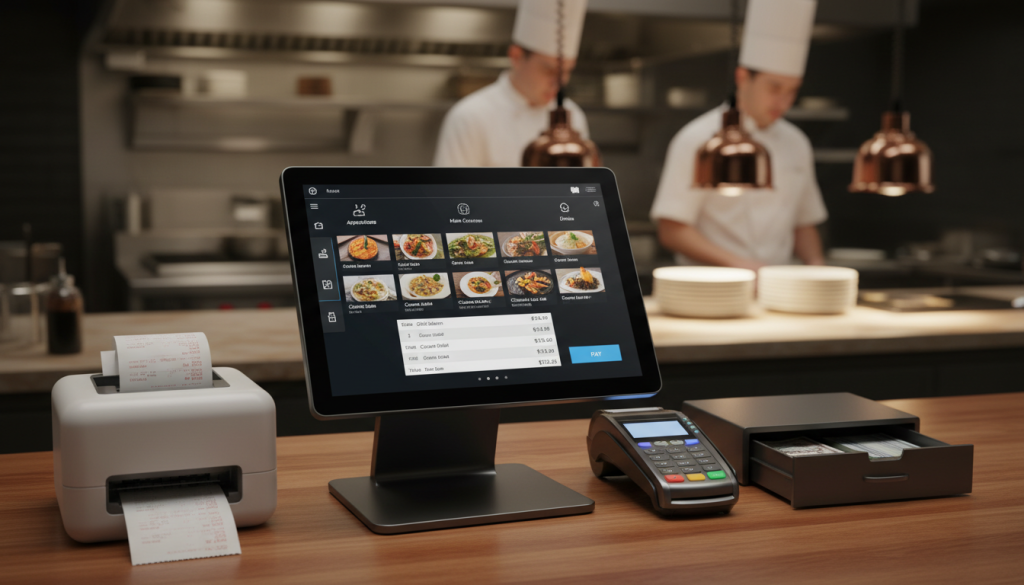
The UK hospitality landscape has undergone a seismic shift over the last few years. For restaurant owners, the challenge is no longer just about serving great food; it’s about managing razor-thin margins, navigating staff shortages, and meeting the digital expectations of a tech-savvy public. At the heart of this struggle—and its solution—is the technology used to manage the floor: the restaurant EPOS system.
Gone are the days when a “till” was simply a box for holding cash. Today, the right point of sale for restaurants acts as the central nervous system of the entire business, connecting the front-of-house, the kitchen, and the back-office into a single, fluid operation.
The Frictionless Floor: Speed and Accuracy
In a busy bistro or a high-volume gastro-pub, seconds matter. When a server has to walk across the floor to a stationary terminal, queue behind a colleague, and manually input an order, efficiency drops. Modern systems have solved this through mobility.
By utilizing handheld point of sale for restaurants, orders are sent directly to the kitchen or bar the moment they are taken at the table. This reduces the “order-to-table” time significantly, leading to higher table turnover and, more importantly, fewer errors. When the system handles the communication, the staff can focus on the “human touch”—the hospitality that actually brings customers back.
Data-Driven Decisions: Protecting Your Margins
With the rising costs of ingredients and energy, guessing your profit margins is a recipe for disaster. A professional restaurant EPOS system provides real-time analytics that allow owners to see exactly what is working.
- Menu Engineering: Easily identify which dishes are your “stars” (high profit, high popularity) and which are “dogs” (low profit, low popularity).
- Inventory Management: Track stock levels down to the individual ingredient. If you’re losing money on steak because of wastage or over-portioning, a modern system will highlight that discrepancy before it ruins your monthly P&L.
- Labour Costing: By integrating staff rotas with sales data, you can identify exactly when you are overstaffed, allowing you to optimize your team for peak hours without burning through your budget during the lulls.
Meeting the Digital Guest
The modern diner expects more than just a paper bill at the end of the night. They want options. Whether it’s splitting a bill between five friends, paying via Apple Pay, or scanning a QR code to order another round of drinks, your EPOS must be agile.
A robust point of sale for restaurants handles these complexities with ease. It allows for seamless bill splitting and integrates directly with card terminals to prevent manual entry errors—a common source of “end-of-night” balancing headaches for managers.
Reliability: The Silent Requirement
Perhaps the most underrated feature of a top-tier restaurant EPOS system is its reliability. In the UK, internet outages happen. If your system is purely cloud-based without an “offline mode,” a simple router failure could bring your entire service to a halt. Leading providers like Cube POS ensure that their hardware is rugged enough for the kitchen environment and their software is resilient enough to keep taking orders and payments even when the Wi-Fi wavers.
Conclusion: Investing in the Future
Choosing an EPOS isn’t just a business expense; it’s a strategic investment. The initial cost of upgrading is quickly offset by the reduction in waste, the increase in table turnover, and the peace of mind that comes with having total control over your data.
For UK restaurateurs looking to stay competitive, the question is no longer if you should upgrade your technology, but which system will best support your unique vision. When your technology works as hard as your chefs, success is the only logical outcome.
