
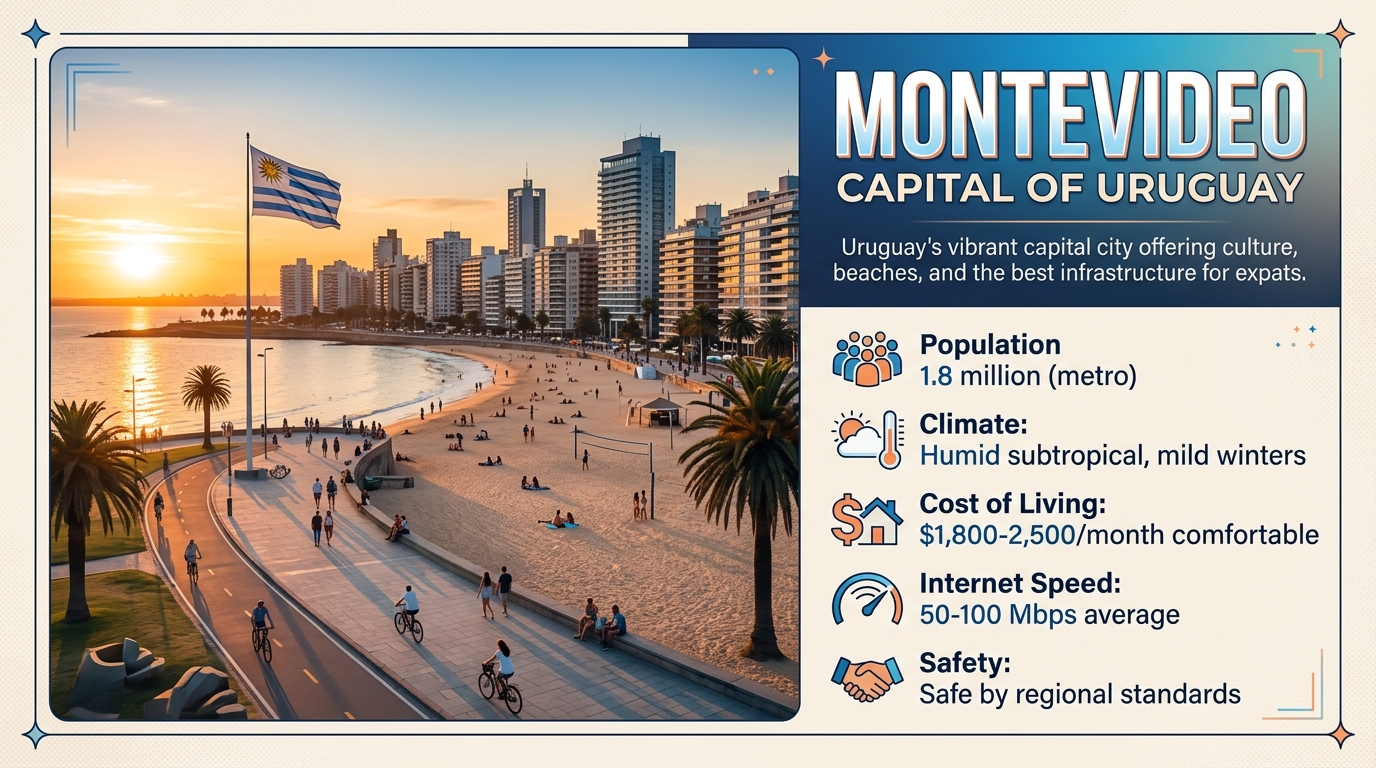
Montevideo is Uruguay’s capital and largest city, home to nearly half the country’s population. This cosmopolitan city stretches along the Río de la Plata, connected by the famous 22-kilometer Rambla waterfront promenade. For those considering a move to South America, the capital of Uruguay offers a compelling blend of European-style urbanism, political stability, and a famously relaxed pace of life.
A Lifestyle Defined by “Tranquilo”
For expats, Montevideo offers the best combination of amenities, services, and community. The city has excellent healthcare, international schools, diverse neighborhoods, and the largest concentration of restaurants, cultural activities, and entertainment.
However, what truly distinguishes the city is its atmosphere. The pace of life is notably relaxed for a capital city. Locals embrace tranquilo as a way of life, gathering for mate—the traditional caffeine-rich herbal infusion—on the beach, enjoying long, multi-hour lunches, and prioritizing quality of life over the relentless hustle found in other global metropolises. It is a city where social connection and personal time are held in high regard.
The Rambla: The Heart of the City
If there is one feature that defines the daily rhythm of the city, it is the Rambla. Spanning over 22 kilometers of continuous coastline, this iconic promenade serves as the city’s “living room.” It connects the various coastal neighborhoods and acts as a central hub for outdoor recreation.
Whether you are looking to jog at sunrise, cycle along the coast, or sit on a stone wall watching the sunset over the Río de la Plata, the Rambla is where Montevideans congregate. It is an integral part of the local identity, offering a unique natural environment that remains accessible to everyone, regardless of their neighborhood.
Top Neighborhoods for Expats
Montevideo’s residential areas offer distinct personalities, making it easy to find a location that suits a variety of lifestyles:
- Pocitos: This is perhaps the most popular neighborhood for those moving from abroad. It offers a dense, walkable urban environment, modern apartment buildings, and direct access to one of the city’s most vibrant urban beaches.
- Punta Carretas: Known for its upscale atmosphere, excellent shopping, and family-friendly vibe, this area features some of the city’s best dining and a prominent golf club.
- Carrasco: For those seeking more space, tranquility, and prestige, Carrasco offers leafy, tree-lined streets and large houses. It is also the home of the city’s most renowned international schools.
- Ciudad Vieja: The historic heart of the city, Ciudad Vieja, is perfect for those who appreciate colonial architecture, bohemian charm, and a central location near the port. It is a place where history meets modern creative workspaces and art galleries.
Infrastructure and Stability
Beyond the lifestyle benefits, the city is a practical choice for long-term residency. As of 2026, Montevideo continues to maintain its status as one of the most stable cities in Latin America. It boasts a high-quality private healthcare system—with hospitals like the Hospital Británico often compared to European facilities—and a robust digital infrastructure. With widespread, high-speed fiber optic internet, the city has become a premier destination for digital nomads and remote professionals looking for a stable, comfortable base.
A Cultural Hub
Montevideo is more than just a place to live; it is a city of deep cultural roots. From the hypnotic beats of candombe music echoing through the streets to the world-famous annual Carnival—the longest in the world—there is always something happening. The city is rich in architectural heritage, blending colonial, Art Deco, and neoclassical styles. Residents can spend their weekends visiting the Teatro Solís for a world-class performance, exploring the galleries in the Ciudad Vieja, or attending a local football match at the historic Estadio Centenario.
Choosing a place to call home involves balancing practical needs with the intangible feeling of a city. Whether it is the safety, the healthcare, or simply the ability to enjoy a walk by the sea every single day, the city remains a standout choice for those seeking a high standard of living in a welcoming, culturally rich environment.
Would you like me to expand on the specific residency pathways for expats or provide more details on the current cost of living in these neighborhoods?
